Locality
Perturbations may not capture the relevant local decision boundary.
A field guide to explainable AI
A research index of LIME variants, recurring challenges, and proposed solutions—so you can compare methods before choosing an explanation.
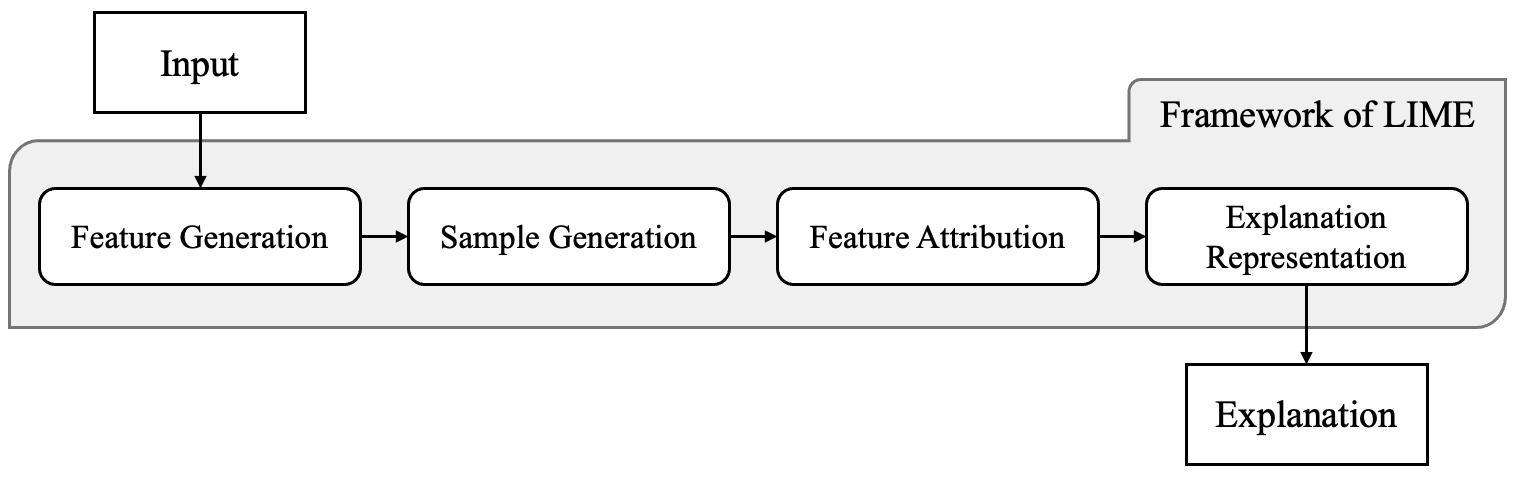
LIME fits an interpretable model around a single prediction. The catalogue tracks where that recipe is extended, challenged, or made more reliable.
The framework
LIME (Local Interpretable Model-agnostic Explanations) is a popular XAI framework designed to explain neural network decisions in a model-agnostic and instance-specific manner. It supports explanations across various data modalities, including images, text, and tabular data. This page summarizes the key components of LIME, its applications, and known issues.
Feature Generation: LIME builds a local, interpretable surrogate model by creating features based on the input modality, such as superpixels for images. Segmentation techniques reduce feature complexity.
Sample Generation: Perturbed samples are generated by selectively modifying features of the input instance.
Feature Attribution: A proximity measure assigns weights to perturbed samples, and a linear surrogate model approximates the original model’s behavior.
Explanation Representation: Explanations are provided based on the coefficients of the surrogate model, highlighting key parts of images, text, or tabular data.
What can make an explanation harder to trust?
Perturbations may not capture the relevant local decision boundary.
The surrogate may not accurately reflect the original model.
The explanation format may not be equally clear across modalities.
Small changes to an input can produce noticeably different explanations.
Generating enough samples and explanations can be computationally demanding.
02 / The catalogue
Search the full index, combine filters, sort any column, or open a row for the paper’s complete record.
| Framework moves | Details |
|---|
03 / The landscape
The grouped view shows how the literature spreads across modalities and application domains. It updates automatically with the catalogue.
| Modality | Domains | Papers |
|---|
04 / Keep it open
Suggest a new method, correction, or code link. Your note goes to the paper maintainers for review.
Send a suggestion ↓Cite the paper
Use either format below when referring to the survey or this research index.
@inproceedings{knab2025lime,
  title={Which lime should i trust? concepts, challenges, and solutions},
  author={Knab, Patrick and Marton, Sascha and Schlegel, Udo and Bartelt, Christian},
  booktitle={World Conference on Explainable Artificial Intelligence},
  pages={28--52},
  year={2025},
  organization={Springer}
}Patrick Knab, Sascha Marton, Udo Schlegel, and Christian Bartelt (2025). Which LIME should I trust? Concepts, Challenges, and Solutions. In World Conference on Explainable Artificial Intelligence, pp. 28–52. Springer.